

Natural Language Processing
Covers JNTUH-Approved Topics – Theory & Lab
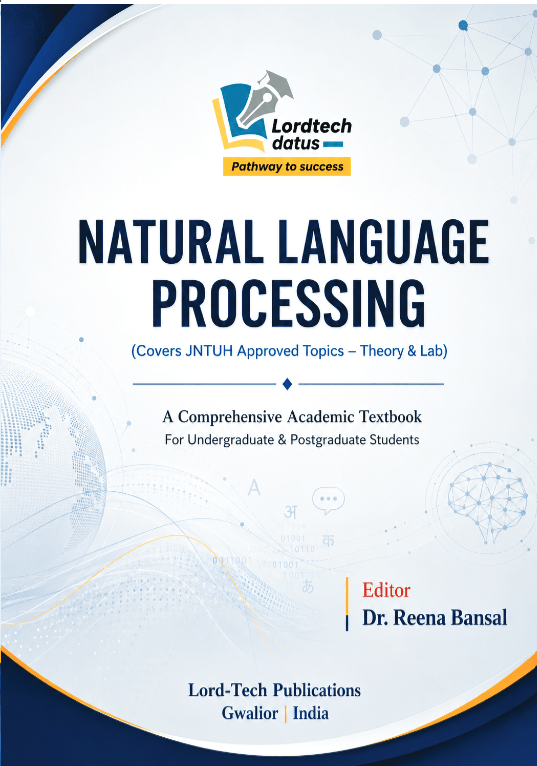
About the Book
“Natural Language Processing” is a comprehensive academic textbook designed specifically for undergraduate and postgraduate students. It covers JNTUH-approved theory and laboratory topics and provides structured explanations of fundamental and advanced NLP concepts.
The book seamlessly bridges core linguistic principles with cutting-edge computational artificial intelligence techniques. Rich with practical examples, clear architectural diagrams, detailed mathematical tables, and structured exercises, it equips learners with both conceptual clarity and hands-on laboratory implementation skills.
Every chapter incorporates Multiple Choice Questions (MCQs), Short-Answer Questions (SAQs), and Long-Answer Questions (LAQs) meticulously organized to support classroom learning, self-study, semester examination preparation, and technical interview success.
Theory & Lab Integration
Complete alignment with JNTUH laboratory exercises & experiments.
Exam-Oriented Bank
MCQs, Short-Answer, and Long-Answer questions at each chapter end.
Visual Illustrations
Intuitive parse trees, grammar graphs, and workflow diagrams.
Multilingual NLP
Deep coverage of cross-lingual and Indian language modelling challenges.
Why Choose This Textbook?
- JNTUH Syllabus Mapped: Strictly follows prescribed university academic syllabus and laboratory guidelines.
- Step-by-Step Algorithms: Clear breakdowns of morphological parsing, CYK parser, Earley parsing, and ambiguity resolution.
- Modern Language Modelling: Covers N-grams, statistical representations, semantic parsing, and modern neural NLP paradigms.
- Student-Centric Pricing: High-quality print production delivered at an accessible price of only ₹300.
- Fast UPI Fulfillment: Direct payment verification with priority courier dispatch across India.
Key Topics Covered
A structured roadmap covering foundational computational linguistics through state-of-the-art semantics and multilingual models.
Structure of Words & Morphemes
Morphemic analysis, stems, affixes, inflectional vs derivational morphology, and word tokens.
Morphological Models
Finite-State Transducers (FSTs), morphological recognition, stemming, and rule-based lemmatization.
Document Structure
Sentence boundary detection, tokenization, text normalization, and structural markup parsing.
Parsing Natural Language
Context-Free Grammars (CFGs), constituency parsing, dependency structures, and syntactic trees.
Parsing Algorithms
Top-down and bottom-up parsing, dynamic programming approaches, CYK parser, and chart parsing.
Ambiguity Resolution
Syntactic and lexical disambiguation, PP-attachment, statistical ranking, and probabilistic grammars.
Multilingual Issues
Linguistic diversity, script processing, tokenization challenges in morphologically rich languages.
Semantic Interpretation
Principle of compositionality, word sense disambiguation, lexical semantics, and WordNet ontologies.
Semantic Parsing
Translating natural language into logical forms, executable queries, and structured representations.
Predicate–Argument Structure
Thematic roles, semantic role labelling (SRL), PropBank, FrameNet, and core semantic relationships.
Meaning Representation Systems
First-Order Predicate Calculus (FOPC), conceptual graphs, semantic networks, and Discourse Representation.
N-Gram & Language Models
Statistical language models, MLE, smoothing techniques (Good-Turing, Kneser-Ney), and perplexity evaluation.
Multilingual & Cross-Lingual Modelling
Zero-shot cross-lingual transfer, multilingual embeddings, translation systems, and modern NLP architectures.
Who Should Read This Book?
Tailored for university students, educators, and technology practitioners in computational intelligence.
Undergraduate Students
B.Tech and BE students in CSE, AI & ML, Data Science, and Information Technology seeking a clear, exam-ready curriculum companion.
Postgraduate & Scholars
M.Tech, MCA, and M.Sc Computer Science students wanting rigorous conceptual explanations, semantic theory, and laboratory models.
Faculty & Educators
Professors and instructors teaching NLP, providing a ready-to-use question bank, lab manuals, and structured syllabus references.
AI / NLP Aspirants
Self-learners and engineers preparing for data science roles, technical assessments, and AI research projects.
Scan QR Code & Pay
Scan with Google Pay, PhonePe, Paytm, BHIM, or any UPI app.

Book Delivery & UPI Order Form
Enter your shipping address, scan the QR code to pay, and submit your UTR reference below.


